
.png)
Grab a drink. Find your seat. Share a laugh.
At Yellow Rose Theatre, it’s all part of the experience.
Secrets
OF

The Real History Behind the Show
Although Club Shush! is a fictional story taking place in a fictional room, many elements of the story and setting are drawn from real history.
Scroll through the years to find the various references and inspirations that went into the story, as well as lists of the audio clips heard through the show!
1920s
(Scene: My Lord!, written by Devin Sugerik)
Our first stop in the past is in 1926. While it wasn't a flu-ward-turned-speakeasy, the building the Bramble Arts Loft is in was actually constructed in 1926 as the Capital Garage which can be found on the facade just north of where you exit the theater!
https://www.edgevillebuzz.com/news/andersonvilles-most-curious-places-capital-garage-5545-n-clark/
While our story takes some liberties with the history of Jeppsons Malört, it was indeed born during this era. Carl Jeppson brought the recipe from his native Sweden and sold it around his new home of Andersonville during Prohibition - this was legal as it was sold as a medicinal tonic for treating parasites! After Prohibition, the drink was a barely-recognized resident of the city until an unexpected cultural frenzy in the early 2010s made it the iconic Chicago beverage that it is today.
https://chicago.suntimes.com/2023/7/8/23787109/malort-jeppsons-unlikely-rise-liquor-alcohol-wormwood

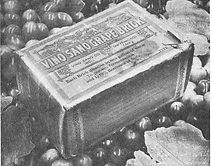
"Wine bricks" were a real phenomenon! Since wine was less economical to smuggle due to its lower alcohol content than moonshine, grape producers dehydrated down their products into a paste like brick and then sold them in packaging with strangely specific warnings about what to avoid in order to not make wine.
https://www.grapecollective.com/prohibitions-grape-bricks-how-to-not-make-wine/

1920s Time Travel Playlist
-
"That's Annabelle" by the Ben Selvin Orchestra (1926)
-
"Ain't Misbehaving'" by Leo Reisman and His Orchestra (1929)
-
Movietone report on the stock market crash on Black Tuesday (1929)
-
1930s
(Scene: The Neighborhood House, written by Madeline Diego)
The character of Viola Spolin is taken straight from Chicago's history. Her work using improvisational games to help integrate immigrants into the community eventually resulted in the Chicago improv and comedy legacy. To learn more, you can check out:
-
Improvisation For the Theater: A Handbook of Teaching and Directing Techniques by Viola Spolin
-
Read about her work direct from the source - including the games used in our show!
-
-
Something Wonderful Right Away: The Birth of Second City: America's Greatest Comedy Theater by Jeffrey Sweet
-
A history of improv and comedy in Chicago. The Second City was co-founded by Viola's son!
-


The Neighborhood House in the play is based on an actual Chicago location - the Hull House. This settlement house was co-founded by Jane Addams, a radical advocate for poor immigrant families. Viola Spolin's early work was mostly with immigrant children at the Hull House, which still stands today - free and open to the public:
1930s Time Travel Playlist
-
"Minnie the Moocher" by Cab Calloway (1931)
-
Roosevelt's First Inaugural Address (1933)
-
"Americans All, Immigrants All" Radio Program (1938)
-
"The War of the Worlds" Radio Broadcast (1938)
1940s
1940s Time Travel Playlist
-
"I Don't Want to Set the World on Fire" by The Ink Spots (1941)
-
Roosevelt's address after the bombing of Pearl Harbor (1941)
-
"As Time Goes By" by Dooley Williams (1943)
1950s
(Scene: The Chicago Spore, written by Joe Bushell)
The Chicago Spore drew historical inspiration from the Chicago Seed, "an underground newspaper published biweekly in Chicago, from May 1967 to 1974; there were 121 issues published in all. It was notable for its colorful psychedelic graphics and its eclectic, non-doctrinaire radical politics. Important events covered by Seed writers and artists were the trial of the Chicago Eight, Woodstock, and the murder of Fred Hampton. At its peak, the Seed circulated between 30,000 and 40,000 copies, with national distribution." Early leaders within the Seed included Don Lewis, Earl Segal, Lester Dore and Abe Peck. The Santa Claus cover by Kratz is a real Seed cover designed by Harry Dewar in 1968.

"Often referred to tongue-in-cheek as 'Mother’s Little Helper,' the tranquilizer Miltown (meprobamate in generic form) an anxiety-relieving drug known for its marked effect, was made commercially available in 1954; it was once one of the most popular prescribed medications. By 1956, doctors had written 36 million prescriptions for it. At the height of its popularity, one out of every three prescriptions called for this drug.'"
https://americanaddictioncenters.org/blog/painkiller-addiction-among-suburban-housewives

"Geneva Summit, (1955) meeting in Geneva of the leaders of the U.S., France, Britain, and the Soviet Union that sought to end the Cold War. Such issues as disarmament, unification of Germany, and increased economic ties were discussed. Though no agreements were reached, the conference was considered an important first step toward easing Cold War tension."

1950s Time Travel Playlist
-
"Gunsmoke" Radio Program (1952)
-
"Heartbreak Hotel" by Elvis Presley (1956)
-
"The Beat Generation" by Bob McFadden (1959)
-
"Americans All, Immigrants All" Radio Program (1938)
1960s
(Scene: After Oz, written by Judy Wolf)

Glinda also has a place in queer history. Her song "Come Out, Come Out" was referenced by Harvey Milk, when he spoke at the San Francisco Gay Freedom Day Parade in 1978 as the first openly gay man to be elected to public office in California. He insisted that the most important act of resistant for gay people was visibility. Milk only served in his position for 11 months before he was assassinated later that year, but his legacy's impact is still relevant today.
Also, it's worth mentioning that the author of The Wonderful Wizard of Oz, Frank Baum, actually lived in Chicago when he wrote the legendary tale. Though perhaps unintentionally, many of his works contain fairly progressive themes on gender and sexuality. Unfortunately, many of his views on issues of race were problematic to say the least - be better, Frank!
Queer Oz: L. Frank Baum's Trans Tales and Other Astounding Adventures in Sex and Gender on JSTOR
The question "Are you a friend of Dorothy?" came about in queer slang as a way for gay men to identify each other without outing themselves when it was often dangerous to do so. While some claim the original Dorothy refers to Dorothy Parker, a New York writer who held lavish parties for her many gay friends, many maintain that the reference is to Dorothy Gale, the character played by Judy Garland in The Wizard of Oz film - queer people could relate to the story of a small-town person wanting something more "over the rainbow".
Whatever the case, Judy Garland became one of the most iconic figures in gay culture. Some believe that her death on the eve of the Stonewall Riots played some part in triggering the revolutionary event in 1969.


1960s Time Travel Playlist
-
"I Have A Dream" Speech by Martin Luther King Jr (1963)
-
"You Don't Own Me" by Leslie Gore (1963)
-
News Report on the JFK Assassination (1963)
-
"House of the Rising Sun" by The Animals (1964)
-
Studs Terkel Interview with Mattachine Midwest - WFMT Chicago (1970)
-
This one wasn't chronological but it was such a great clip from a local source that we had to use it!
-
1970s
1970s Time Travel Playlist
-
"Time in a Bottle" by Jim Croce (1972)
-
"The Time Warp" from the Rocky Horror Picture Show (1973)
1980s
(Scene: Violette's, written by JD Hartner)
Violette's used the iconic and informative 1990 documentary Paris is Burning as a key historical touchstone. The film follows several “houses” prominent in the New York City ballroom scene and the many transgender individuals and drag queens involved in. “Critics consider the film to be an invaluable documentary of the end of the “Golden Age” of New York City Ballroom scene, and a thoughtful exploration of race, class, gender and sexuality in America.”
https://en.wikipedia.org/wiki/Paris_Is_Burning_%28film%29?wprov=sfla1"


Another little bit of physical history in the show, Veronica's makeup kit is an original Caboodles case from the late 1980s. Legend has it that the idea was inspired by a 1986 photo that showed Wheel of Fotune co-host Vanna White with a tackle box that she kept her makeup in. It soon became a sensation among teenage girls...and perhaps the occasional drag queen.
1980s Time Travel Playlist
-
"I'm Coming Out" by Diana Ross (1980)
-
Advertisement for IBM Personal Computers (1983)
-
"Relax" by Frankie Goes to Hollywood (1983)
-
News Report on the First Unveiling of the AIDS Quilt (1987)
-
"Heaven is a Place on Earth" by Belinda Carlisle
1990s
(Scene: Benny's Last Dance, written by Anna Joy Yee)
While Benny’s Bar and the characters portrayed in Benny’s Last Dance are fictional, the Chicago Bulls game and sports announcer clips are based on accurate historical events.
The play opens on Friday, June 13, 1997, during Game 6 of the NBA Finals between the Chicago Bulls and the Utah Jazz. The Bulls enter the game leading the series 3–2, meaning a win would secure their fifth NBA championship in seven years. In front of a packed United Center crowd, Chicago defeats Utah 90–86, with Michael Jordan bouncing back from food poisoning in the Game 5 “flu game,” scoring 39 points, and Steve Kerr hitting the game-winning shot in the final minute.
https://en.wikipedia.org/wiki/1997_NBA_Finals#Game_6


For Chicago sports fans, Game 6 became one of the defining moments of the 1990s Bulls dynasty and sparked citywide celebrations that culminated in a massive championship rally downtown 3 days later, with Kerr poking fun at Jordan.
https://www.si.com/nba/bulls/onsi/old-school/how-the-chicago-bulls-won-game-6-vs-the-utah-jazz-in-the-1997-nba-finals
https://www.netflix.com/search?q=the%20last%20dance&jbv=80203144
Benny’s Last Dance also references the redevelopment of downtown Chicago and future city construction. During the late 1990s, the pressure of redevelopment reflected real changes occurring across Chicago. Older businesses often faced uncertainty as the city invested heavily in new civic projects. The juxtaposition of a changing city and the Bulls' championship run underscores one of the play's central themes: preserving community and legacy while facing inevitable change.

1990s Time Travel Playlist
-
"Smells Like Teen Spirit" by Nirvana (1991)
-
Commercial for Moo & Oink, a South Side Chicago meat company (1992)
-
"I Will Always Love You" by Whitney Houston (1992)
-
Cochran's closing arguments from the OJ Simpson Murder Trial (1995)
-
"Wannabe" by The Spice Girls (1996)
-
Coverage of Game 5 of the 1997 NBA Finals (1997)
2000s
1930s Time Travel Playlist
-
"I Want it That Way" by Backstreet Boys (1999)
-
News report on the Y2K Bug (1999)
-
"Jumpin' Jumpin'" by Destiny's Child (2000)
-
News report on the 9/11 attack on the World Trade Center (2001)
-
"Lose Yourself" by Eminem (2002)
-
"Umbrella" by Rihanna (2007)
-
News report on the 2008 recession (2008)
-
"I Gotta Feeling" by Black Eyed Peas (2009)
2010s
(Scene: Hello from the End of the World, written by Alex Fortune)
From the Smithsonian National Museum of the American Indian: "December 21, 2012 marked the end of an important cycle in the Maya Long Count calendar. This cycle is composed of 13 periods, called baktun, of 144,000 days each. This 13-baktun cycle began on the Long Count calendar date 13.0.0.0.0 4 Ajaw 8 Kumk’u, and spans 5,125.366 solar years."
"Monument 6 [shown here], from the archaeological site of Tortuguero in Tabasco, México, records the only known Maya inscription of the end date of the 13-baktun cycle. This end date, 13.0.0.0.0 4 Ajaw 3 Kank’in, corresponds to December 21, 2012. There is no evidence in these inscriptions, or in any other record, that the ancient Maya thought that the Long Count calendar would imply some kind of catastrophic “end.” These predictions were unfounded and are not shared by the Maya people."


2012 also brought us an explosion in the term YOLO ("YOH-loh"), the instantly-irritating abbreviation of "You Only Live Once" - a term which has existed since the 19th-century. Though the early-2010s popularity of the abbreviated term is accredited to Canadian rapper Drake's hit single, "The Motto", this wasn't the first time it was used. The Grateful Dead's drummer, Mickey Hart, and his wife named their ranch with this acronym in the early 90s.
2010s Time Travel Playlist
-
News report on the Maya 2012 Apocalypse scare (2012)
-
"Call Me Maybe" by Carly Rae Jepsen (2012)
-
"Happy" by Pharrell Williams (2013)
-
News report on federal legalization of same-sex marriage (2015)
-
"Despacito ft. Daddy Yankee" by Luis Fonzi (2017)
2020s
(Scenes: Shush! and Shush! Reprise, written by Sean Frett)
While the Prohibition Era has always carried a degree of mystique with it, the onset of another 20s decade has re-sparked many people's interest in the time.
The music heard upon entering Club Shush celebrates this combination of new and old with modern songs redone in a 1920s style. If you enjoyed it, check out Postmodern Jukebox - they have a huge library of just this kind of thing!

2020s Time Travel Playlist
-
Early news report on the COVID-19 pandemic (2020)
-
"good 4 u" by Olivia Rodrigo (2021)
-
News report on increased prevalence of generative AI
-
"Good Luck, Babe!" by Chappell Roan (2025)
-
"RUNWAY" by Lady Gaga & Doechii (2026)
We hope you enjoyed this little journey through time with us!
If you have enjoyed this production, please consider a donation to Yellow Rose Theatre so that we can continue to provide a home for original works and local Chicago artists. We are so grateful for all of your support!